The most dangerous sentence AI writes is one that looks right but isn’t.
Nothing in the AI framework announced by the Australian Government today reduces the risk of AI making mistakes.
AI fluency and prompt engineering are rapidly becoming core skills as the communications profession increasingly uses AI to help with content production. But we mustn’t forget that a communicator’s real work is in exercising judgement, not generating content.
When AI goes off the rails
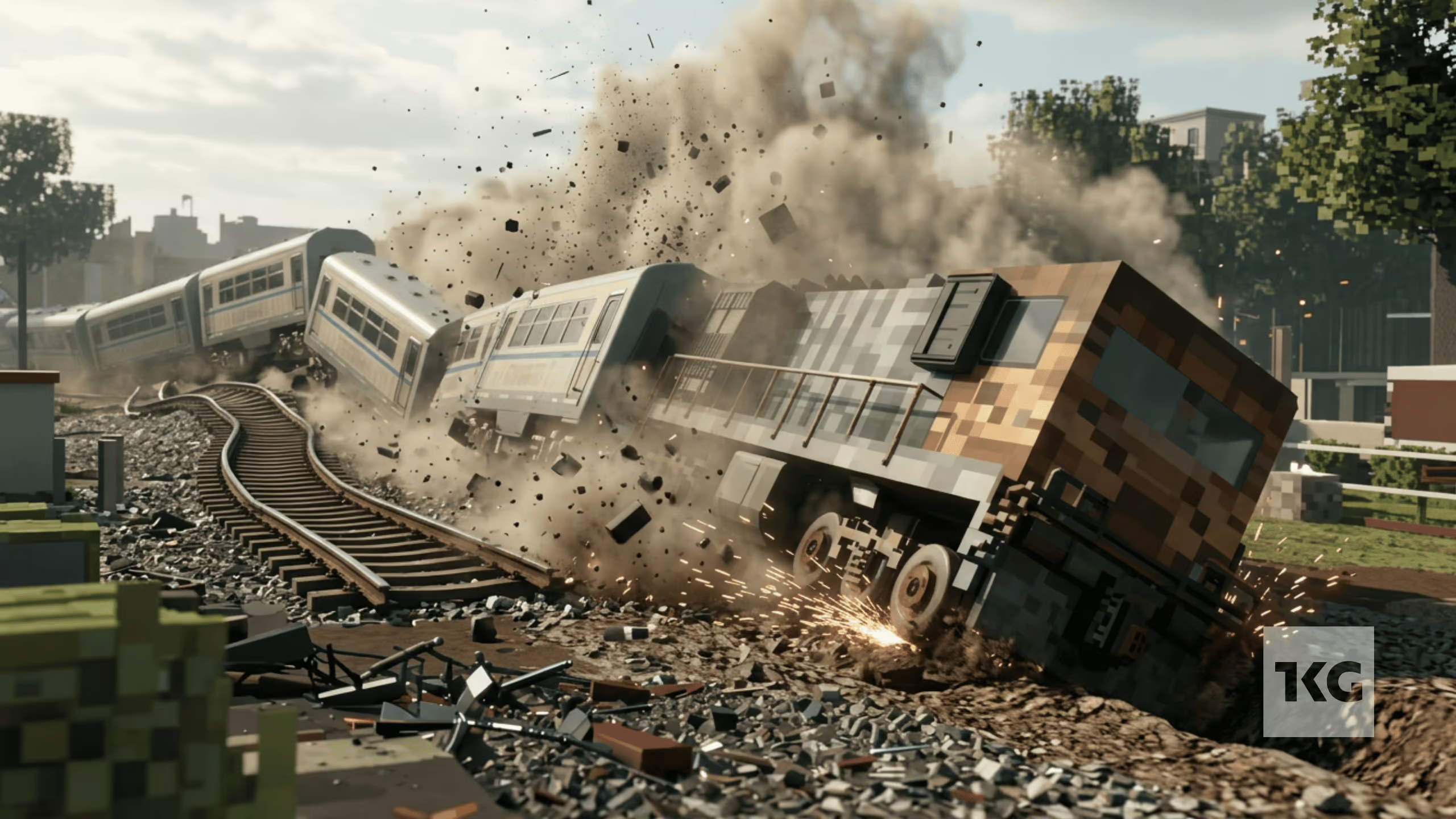
You’ve probably seen these well-publicised train wrecks where AI went wrong:
- Last year, Deloitte Australia refunded part of the $440,000 cost of a report it produced for the Department of Employment and Workplace Relations after it was found to contain multiple AI hallucinations.
- Air Canada was forced by a tribunal to honour a bereavement policy invented by its chatbot and relied on by a customer.
- The Chicago Sun-Times and Philadelphia Inquirer apologised last year after they published a syndicated summer reading list recommending books that didn’t exist.
If you’ve used AI a lot you’ve probably experienced AI hallucinations – but hopefully picked them up before using them.
And this is my point: you make the difference whether the AI train goes off the rails or not.
Sense check and fact check
We’ve spent much of our communications careers focusing on improving the writing – getting the tone right, rewording for clarity, correcting the misplaced apostrophe, checking for compliance with house style – instead of the accuracy of the content.
We assumed the “subject matter expert” got the facts right or that well-written content was probably written by someone competent.
Now, we can train AI to write excellent content – even writing in a particular writer’s style or following arbitrary style guides. We still need to give what it creates a “sense check” and a “fact check”.
Responsibility for AI’s work rests with you, not the tool or its maker. If you’re using the tool, it’s your responsibility to check its work.
In every one of the train wrecks above, the organisation, not the AI tool, was ultimately responsible for its AI content, whether or not they wanted to be. And every disaster had a significant cost in reputation damage.
The fast part isn’t the hard part
Anyone thinking that AI is doing their work for them when it can produce a first draft in seconds has mistaken the fast part of their job for the hard part.
The hard part is judgement: the editorial instinct to catch the sentence that’s confident but wrong, the tone that’s technically fine but will land badly, the strategic insight the model can’t see because it doesn’t know everything you do (yet).
I’ve always said that “good communications is just good common sense, but common sense isn’t”. Not everyone has common sense.
AI still hasn’t got it either, so it hasn’t replaced the need for human judgement.
Organisations that will do well in the agentic era won’t be the ones that rely on AI the most; they’ll be the ones that use it wisely as a tool in human hands with human oversight.